How It All Went Wrong (Before It Even Began)
If you look at a map, although travelling to Japan from Europe or America is so damn far you might as well visit the moon instead, one of the benefits of growing up in Hong Kong is that you can visit the neon-lit streets in Tokyo or the bustling shopping districts of Osaka in just over four hours. This, combined with the weak yen, meant that since the early 2000s, Japan has been one of the top tourism destinations amongst Hong Kongers.
I was definitely fortunate to be able to travel at such a young age. When I was six, enticed by the prospect of a discount flight deal, my parents decided to plan a family trip to Tokyo and Shanghai over the summer. As soon as I learned that we’d be going to Japan, I was ecstatic. This was finally my chance to experience all the things people talked about on TV.
‘I want to go to Tokyo Disneyland!’ I begged Dad.
‘Look at this onsen! I want to stay at this hotel!’
‘I want to eat at the biggest sushi restaurant!’
Unfortunately for me, it seemed that my parents already had something in mind, something big.
‘Son, ever heard of Fujisan?’
‘Say what?’
That’s right, I’d only later found out that not only would we not even be visiting the front gates of Disneyland, but Dad had arranged for us to climb Mount Fuji. Oh dear.
A symbol of Japan, this stratovolcano is no ordinary mountain. Formed from a composite of three successive volcanoes, the present-day mountain is revered for its natural beauty, with its near-perfect conical shape and its intermittent volcanic activity. The awe Mount Fuji inspired has made it a site of reverence for religions, including Shintoism and Buddhism, both of which believe the mountain to be a sacred sanctuary where the gods reside. As such, each year, over 300,000 climbers would journey to this UNESCO World Heritage site to pray for good health and fortune. Little did I know we’d be amongst them.
It wouldn’t be just the three of us either. Joining us on our ascent were my good friend Ryan and his family. Ryan is one of my oldest friends. We’ve known each other since the first year in kindergarten, and over time, our families too got on well, such that we would regularly visit their home for dinner gatherings and celebrations, even to this day.
Ryan’s two uncles, Matthew and Wallance, have heard about our trip and were eager to join us.
‘The more the merrier!’ Dad cheered.
But that’s not to say there weren’t any concerns over the climb.
Scaling Mount Fuji and reaching its 3,776 m peak normally takes two days, three if you begin from the base of the mountain. Climbers would begin late in the morning, slowly make their way up to one of the mountain lodges, and stay the night before continuing at around 2 am, just in time to reach the summit to watch the goraiko sunrise.
In the months leading up to the trip, however, our families had discovered reviews about some of the lodges, mainly about how shit they were. Conversations with friends and photos online further convinced us of the terrible sleeping conditions up there.
‘The pillows are literally made out of concrete!’ one reviewer complained.
‘The snoring was unbearable!’
And having stayed in a few of them in recent years, I can attest to those reviews being accurate.
Staying at those lodges is, in essence, sharing a coffin with 20 strangers. What’s more, if you’re expecting a three-course omakase dinner when you finally reach the 3200m-high station, prepare to be sorely disappointed, as nearly every single lodge serves cheap microwaved curry with biscuits that taste like they’re from the Meiji period.
‘We are categorically not staying in those lodges.’ Uncle Matthew insisted.
After prolonged discussions, we decided not to book any accommodation on the mountain and instead fit the entire climb into a single day. A decision that would come back to haunt us.
Onward, Into Misery
‘Everybody ready?’
‘Let’s go already!’
The day has come. It was 7:30 in the morning, and we were driving up to Station 5, about to begin our climb.
In total, Mount Fuji has four major climbing routes: Gotemba, Subashiri, Fujinomiya, and Yoshida, the most popular of the four and the one we’d decided to take. The Yoshida Trail has always been regarded as the easiest due to its far more gradual incline and the abundance of lodges and facilities available. It features ten stations, and while the tenth refers to the summit, most people typically begin their ascent at station 5, 2400m above sea level.
Nowadays, getting to the fifth station requires you to take a 1-hour coach from Kawaguchiko station. But back in 2010, it was still very much possible to drive up there, that is, if there were still spaces left for you to park.
‘Dame! It’s full!’ A stern-looking Japanese man walked over, waving his glowing red baton like he was in a Star Wars film.
‘Is there anywhere else we could park? The traffic down there is really bad!’ Dad begged.
‘More car parks down below!’
‘Yeah, but they told us they’re full as well!’
‘Eh… go down, maybe roadside?’
As luck would have it, two kilometres down the road, Dad managed to find an empty spot, barely big enough to fit our car. We put on our backpacks and began to make our way back up to the station.
‘Dad? How long is the hike gonna take?’ I checked my watch.
‘Let’s see… It’s 8:30 now, I guess we’ll be back by 9 pm at the latest?’ Dad looked over, pulling the smuggest expression known to man.
For those of you who’ve studied maths, you’ll quickly realise that this meant climbing for over 12 hours, and there’s actually a name for tackling Mount Fuji this way – dangan tozan, literally bullet-climbing. According to the sign at the start of the trail, ‘14% of bullet climbers give up climbing to the summit because they become ill.’
How comforting.
Furthermore, in recent years, due to over-tourism and the heavy congestion on the mountain, the local government has straight-up banned this method of climbing. As of 2025, only people who have reserved a night at one of the lodges are permitted to ascend Mount Fuji.
But maybe it’s because I was still half-asleep, or the fact that I had no concept of time, I remember simply thinking to myself – ‘Oh, 12 hours, that’s not too bad, I can do that!’
I think you can probably guess what happened next.
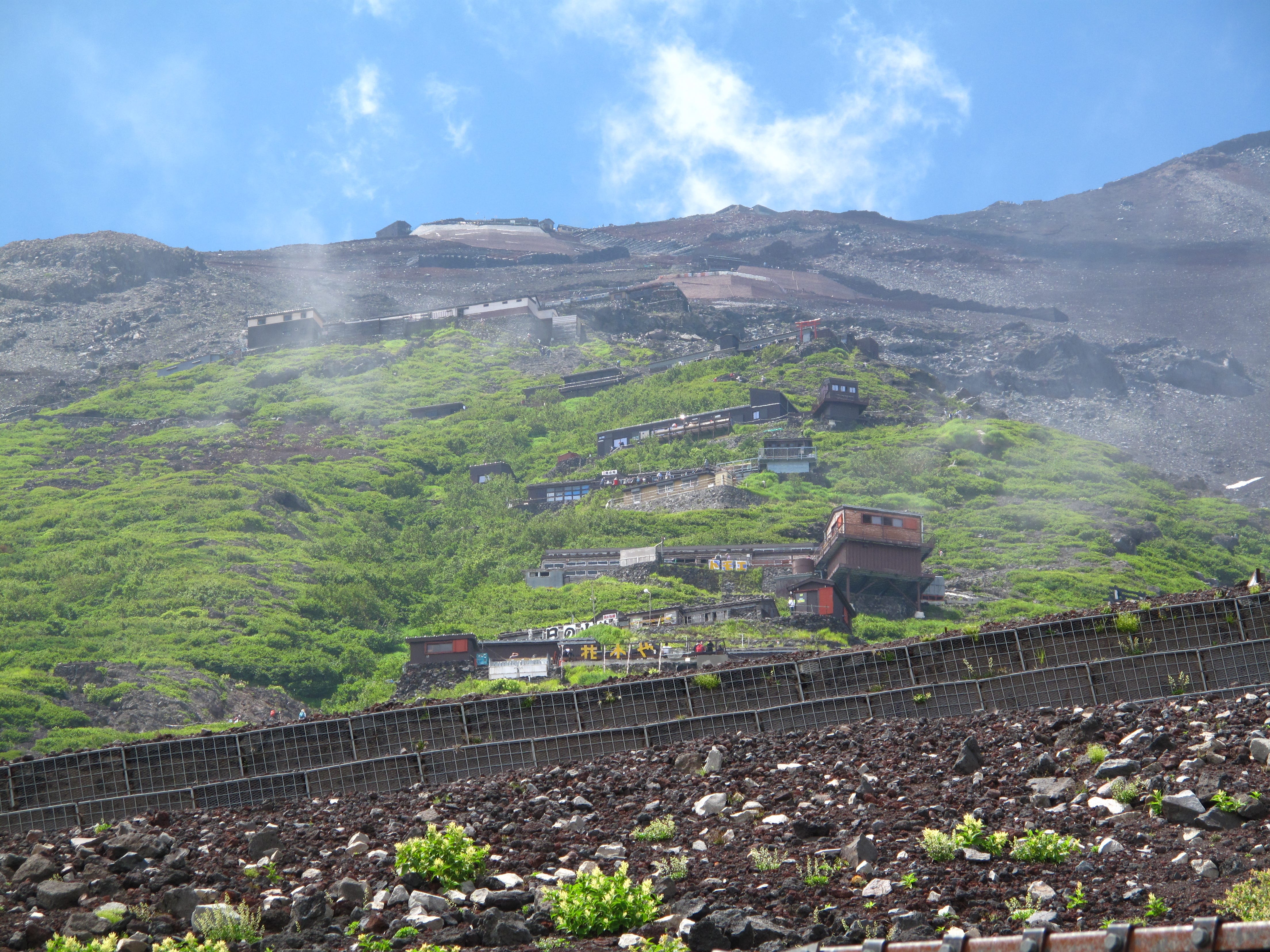
Setting foot on the fifth station for the first time was certainly an interesting experience, to say the least. Despite it being so high up, it felt more like arriving at Piccadilly Circus than beginning a climb up a sacred mountain. There were ice cream stalls, two-story souvenir shops, and even restaurants selling Mount Fuji-shaped curry rice. One shop in particular that caught Ryan’s and my attention was selling various wooden hiking poles.
‘What are those?’ I turned to Mum.
I soon found out that one of the ways the huts on the mountain get climbers to spend money was to encourage them to buy one of these sticks, where, at different stations, climbers can have it stamped as a way to commemorate their journey. Quite ingenious, if you ask me.
‘This one, very short, good to carry!’ A member of staff came out to greet us.
While it does sound pretty cool on paper, having your own Fuji stamp collection, keeping in mind that in addition to the stick, every stamp costs 300 to 500 yen, you could be looking at spending over 7500 yen or 50 USD if you end up collecting every single stamp along the way, which is of course, enough money to start your own stamp company.
‘Maybe next time.’ Dad told the staff.
And off we go! Only about an hour in, and we’ve made it to the sixth station. As we sat down to take a break, I noticed a row of portable toilets in the distance, all of which had a coinbox on the side of the door.
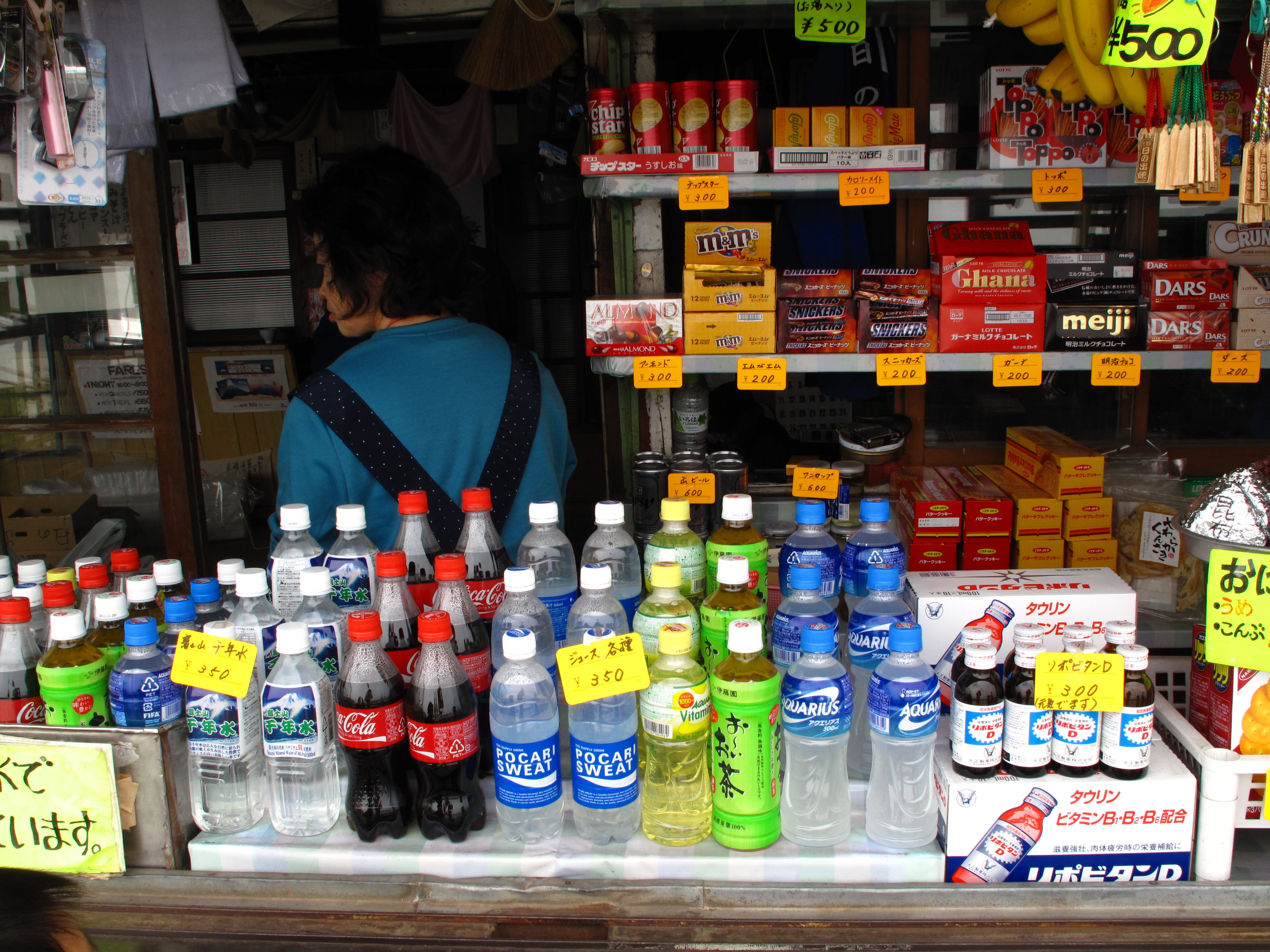
If there’s anything you can’t climb Mount Fuji without, it’d be coins, lots of coins. While toilets and vending machines are virtually everywhere, their prices increase incrementally the higher you ascend. Say for a bottle of tennensui water:
5th station – 250 yen
6th station – 300 yen
7th station – 390 yen
So in a way, you can work out how high up you are by simply checking how much it costs to buy a bottle of water.
A couple of pit stops down, we were on our way to the eighth station. As mentioned earlier, taking the most popular route meant that congestion was inevitable, but stopping every now and then did give me much-needed time to catch my breath. Especially with the air getting thinner with every step, the shortness of breath can really get to you.
As we approached station 8, out of the blue, a Japanese trail runner, decked out in running gear, blew past us like a human tomahawk cruise missile.
‘Gabbatte kudasai! Best of luck!’ He cheered us on.
‘Man, if we were walking this fast, we would be back at our hotel by now!’ I thought to myself.
Although part of me wanted to see if I could catch up to him, my legs didn’t necessarily share my enthusiasm.
But in stark contrast to the trail-running madman, we also came across an older gentleman, resting in front of one of the lodges, who looked like he was on his deathbed. He was speaking to his friends in Japanese, but my mind kept imagining what he was saying.
‘My friends… it has been a pleasure, climbing Mount Fuji with you…’
‘Don’t go, Kenji! You still owe us that cup of noodles!’
One of his friends handed him a tiny blue canister, and he started inhaling from it.
‘PORTABLE HIGH-PURITY OXYGEN – 99.5% pure oxygen’
‘Ridiculous!’ I scoffed.
‘No way a bottle of that size could be of any use!’
If anything, it felt like yet another souvenir for climbers to get to prove that they’ve climbed the mountain.
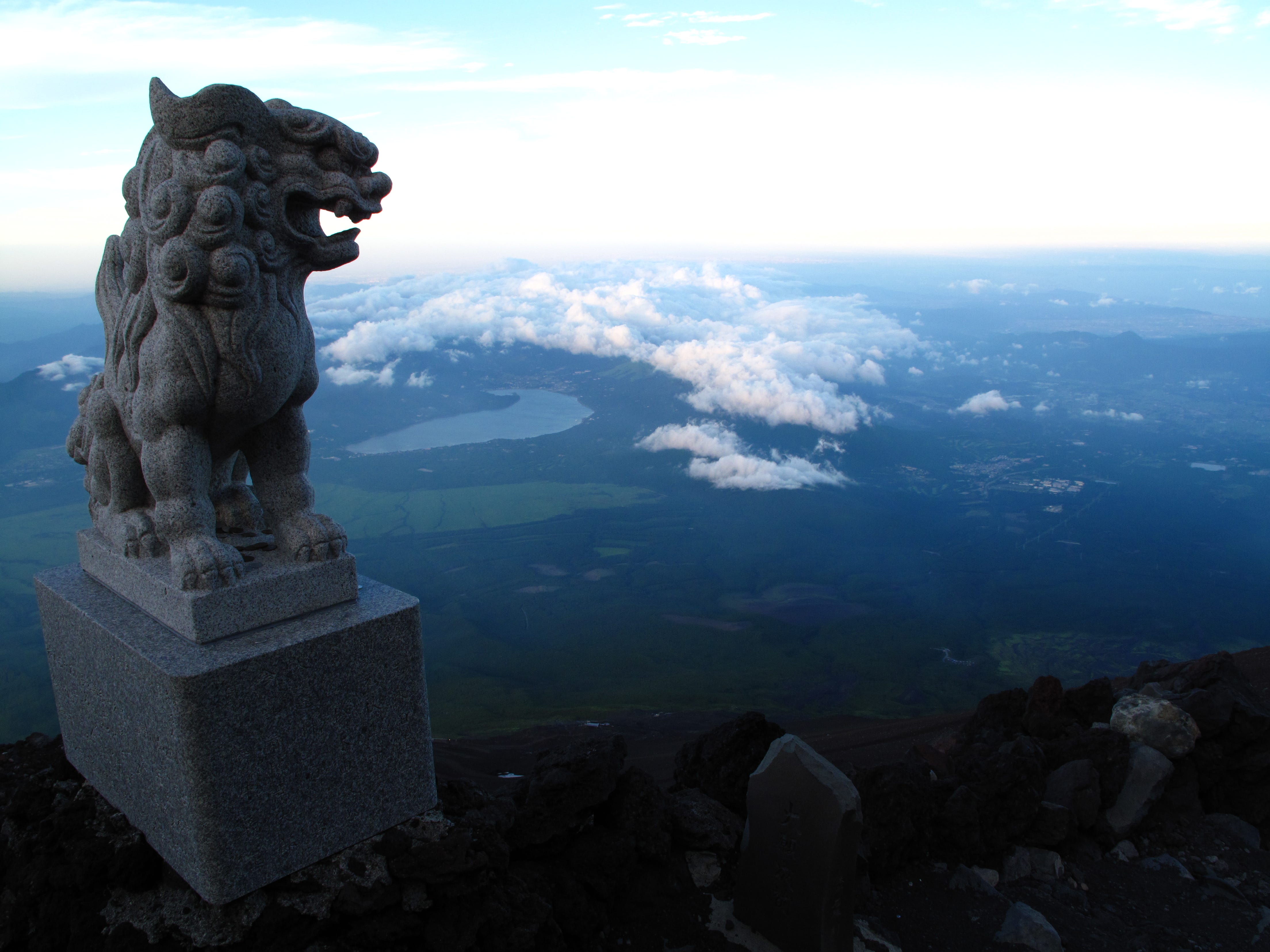
Taking a break at station 8, the clouds gradually cleared up. On Mount Fuji, visibility comes and goes, but when it was clear, looking down from 3200 m was undeniably spectacular. Particularly in the late afternoon, with the sun behind the mountain, I recall seeing the silhouette of Mount Fuji cast over the entire city below. It puts to scale just how damn big the mountain is. Truly an incredible sight to behold.
But there was no time to rest. As we continued our ascent to the ninth station, I realised we were seriously falling behind. Not only that, but the incline leading up to the summit was rapidly increasing. It was then that my smile and giddy optimism quickly dissipated.
Glancing down at the black volcanic soil as I struggled to pull myself up the steps, I couldn’t help but wonder what would happen if the volcano were to erupt whilst we were still on the mountain, 3500 m in the bloody sky.
By the final stretch, everyone was looking equally depressed. Every step felt like lifting a boulder. Even cup ramen started to become tasteless. If it weren’t for the people and the view along the way, I think I would’ve given up long ago.
‘Come on, everyone! We can make it!’ Dad cried out, holding my hand.
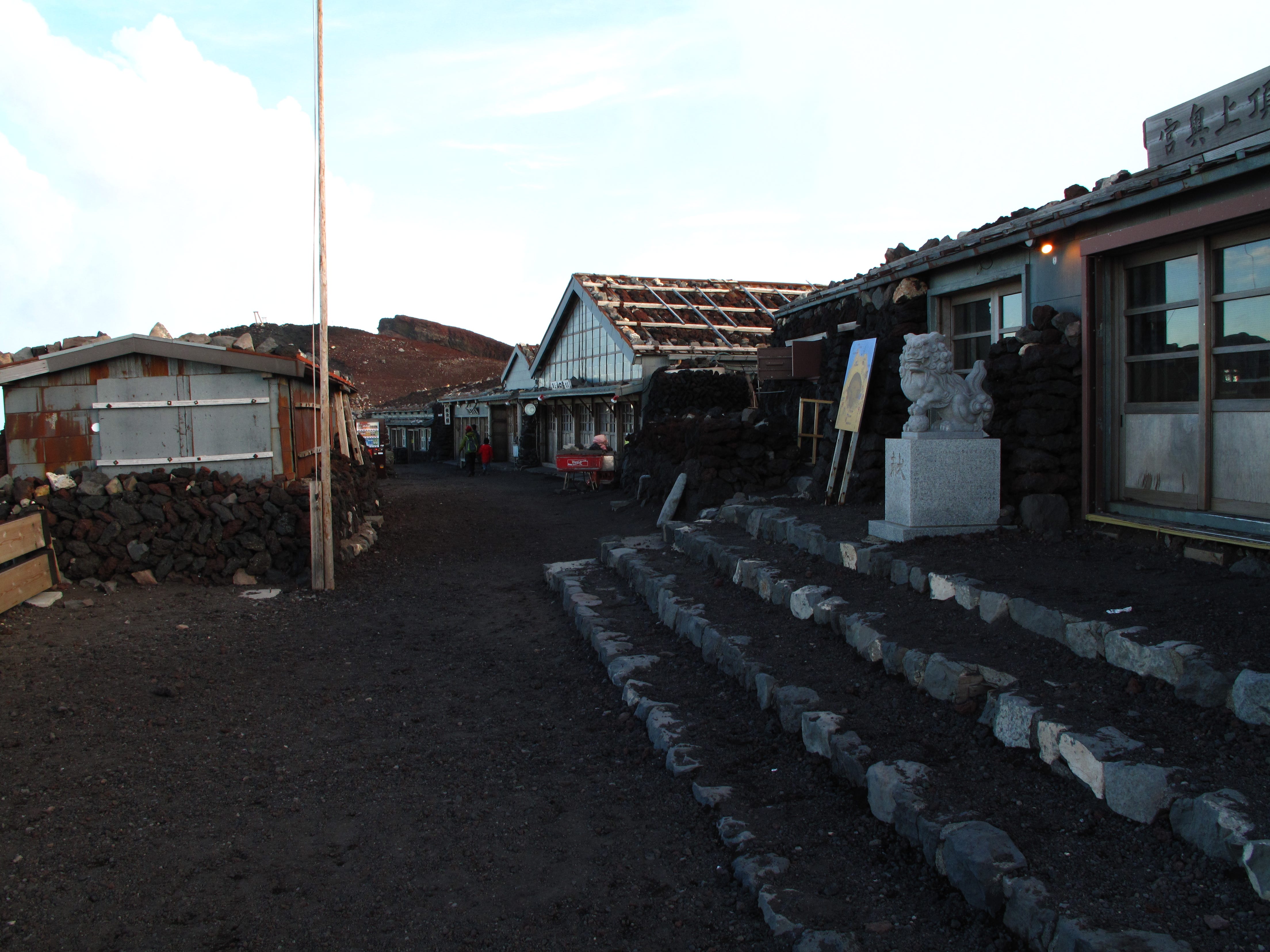
Normally, when you reach the peak in the early morning hours, it would arguably be the busiest place on the mountain. Stores along the crater offer anything from hot coffee to craft beer (Though drinking alcohol on top of Mount Fuji that early in the morning feels more like a suicide attempt to me). There is also the famous post office that allows summiteers to send postcards to family and friends.
But for us, when we finally arrived at the summit, 6 in the afternoon, with the sun setting in the distance, everything but the degraded stone building where the toilet was shut. There was practically nobody.
‘Are we there yet? I asked.
‘Yes! Look over there! Well done!’ Dad pointed to the stone monument up ahead.
We quickly walked over to take a couple of pictures. But in all honesty, during the brief 20 minutes on the summit, I had barely any idea what was going on, let alone having the energy to smile for the camera.
Checking the time, I knew we weren’t going to make it back by 9, and the possibility of us getting stranded on the mountain now seemed more likely than ever.
As a naive 6-year-old boy, I kept thinking that getting back down would be far easier, considering you’re not fighting against gravity anymore, but the pain every time I stuck my foot into the soil to break was beyond unbearable.
With the sky turning pitch black and my arguably crappy headlamp becoming my only source of light, it felt like being trapped in an empty void. There is nothing more discouraging than not knowing how much progress you’ve made, and how much further you’ve to go. I stopped for a moment to catch my breath, wondering why the hell I didn’t get myself a can of oxygen.
Alas, we were back at the sixth station, less than an hour away from the trail start. But I couldn’t take it anymore, I cried and screamed, begging Dad to carry me on his back.
‘Please, Dad! I can’t anymore!’ I sobbed.
‘Come on! We’re at the sixth station already!’
‘No! No! It’s too much! I really can’t!’
After enduring my unrelenting pleading for some time, he finally gave in. I sat on Dad’s shoulder as we slowly made our way back to Station 5 at 11:00 in the evening.
‘Oh my god… is that…?’
‘We’re back?!’
Finally returning to the fifth station, Ryan and I looked around the eerily empty plaza and quickly spotted a bench next to the toilet. We rushed over and lay ourselves down. The next thing I knew, I was in a hotel room the next morning, with a clear view of Mount Fuji out the window.
‘Mum? What happened last night?’
‘Well, not much, Dad picked up the car and drove us back.’
‘Uncle Matthew and Wallance were pretty exhausted, too.’
‘So, how did you find it?’ Dad walked over.
I didn’t really answer him. I simply smiled and nodded. Suffice to say, I had no plans to climb any more mountains with him ever again.